WebElements Home WebElements

Reason: Cybersecurity !!better!!

No matter how advanced our security technologies are, they can't replace human judgment. Firewalls, intrusion detection systems, and artificial intelligence can all provide valuable insights, but they lack the nuance and context that only a human mind can provide. A well-reasoned approach can help cybersecurity professionals evaluate the output of these systems, identify potential false positives, and make informed decisions about incident response.

To cultivate a culture of reason in cybersecurity: reason cybersecurity

Highly funded groups aimed at long-term infiltration. No matter how advanced our security technologies are,

In the realm of cybersecurity, technology and innovation often take center stage. However, amidst the excitement of new tools and techniques, a crucial element can get overlooked: reason. The ability to think critically, analyze situations, and make informed decisions is essential for effective cybersecurity. In this piece, we'll explore the importance of reason in cybersecurity and how it can help organizations stay ahead of threats. To cultivate a culture of reason in cybersecurity:

By embracing reason and critical thinking, we can build a more secure and resilient digital world.

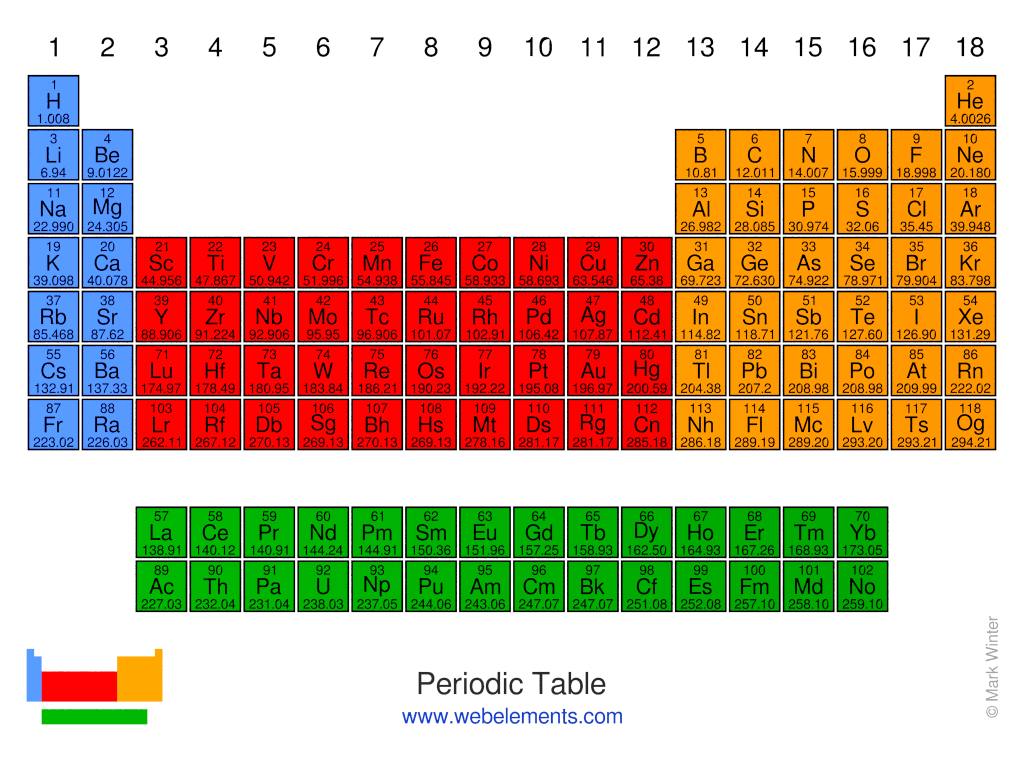
The International Union of Pure and Applied Chemistry (IUPAC) confirmed the names of elements 113, 115, 117, and 118 as:

This followed a 5-month period of public review after which the names earlier proposed by the discoverers were approved by IUPAC.

You can buy this periodic table poster and more at the WebElements periodic table shop.
Periodic table cartograms poster

On 1 May 2014 a paper published in Phys. Rev. Lett by J. Khuyagbaatar and others states the superheavy element with atomic number Z = 117 (ununseptium) was produced as an evaporation residue in the 48Ca and 249Bk fusion reaction at the gas-filled recoil separator TASCA at GSI Darmstadt, Germany. The radioactive decay of evaporation residues and their α-decay products was studied using a detection setup that allows measurement of decays of single atomic nuclei with very short half-lives. Two decay chains comprising seven α-decays and a spontaneous fission each were identified and assigned to the isotope 294Uus (element 117) and its decay products.

Images of various periodic tables

Click on the images below to see images of the periodic table in a variety of styles.

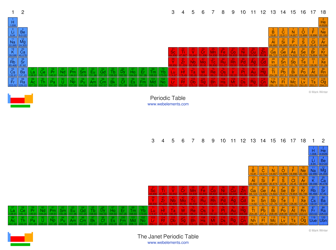
Icon showing a standard periodic table
See standard periodic table images.

Icon showing a spiral periodic table
See image of spiral periodic tables.

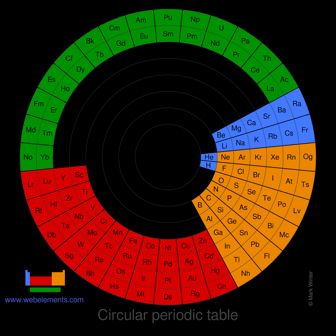
Icon showing a circular periodic table
See images of circular periodic tables.

Icon showing extended periodic tables
See images of extended periodic table.